
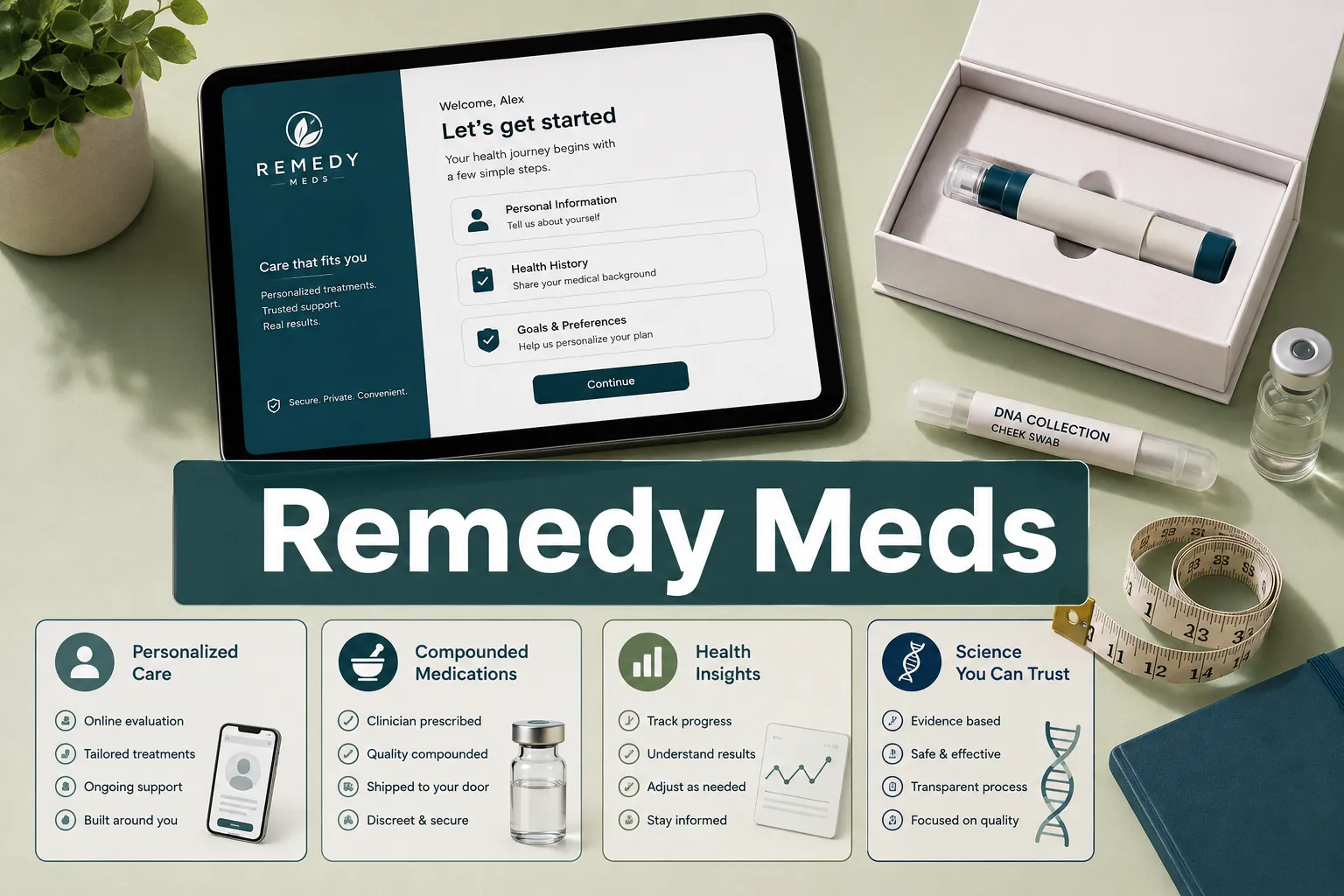
MUST SEE: I Almost Skipped Remedy Meds Until I Saw THIS!
Remedy Meds: A Review of Public Ratings, Regulatory Status, and Complaint Records
Published: August 18, 2026 Scope: Publicly available rating data, editorial reviews, and consumer complaint records for Remedy Meds LLC, a direct-to-consumer telehealth provider of compounded GLP-1 medications.
Summary
Remedy Meds is an operating US telehealth company that connects patients with licensed providers who may prescribe compounded semaglutide or tirzepatide. It is not a pharmaceutical manufacturer, and the medications it dispenses are not FDA-approved.
Public assessments of the company diverge sharply, and the divergence is itself the main finding:
| Source | Rating | Sample |
|---|---|---|
| Trustpilot | ~4.6 / 5 | 6,500+ reviews |
| Forbes Health (hands-on tester) | 4 / 5 | Single tester, April 2026 |
| Better Business Bureau | F (not accredited) | Complaint-based, not a star rating |
The gap is not random noise. Trustpilot aggregates solicited post-purchase feedback, which skews toward the onboarding and delivery experience — the parts of the service that work well. The BBB record captures disputes, which cluster in billing, cancellation, and refunds. A reader consulting only one of these sources will form a materially incomplete picture.
Correction of figures in circulation
Several numbers about Remedy Meds circulate in secondary coverage and do not survive checking. This report does not use them:
- “A low letter grade” at the BBB. The actual rating is F, the lowest on the scale, and the company is not BBB-accredited. Contemporary coverage attributes it to failure to respond to complaints and to complaint volume relative to company size. Softening “F” to “a low letter grade” understates the finding.
- “3.08 / 5 from 39 reviews” at the BBB. BBB customer-review star averages are a separate, low-volume metric from the letter grade and should not be presented as the BBB’s assessment.
- “1.2 / 5 across 181 reviews” on ConsumerAffairs. We could not verify this count. At least one prior analysis notes that ConsumerAffairs review counts for this company were not reliably extractable. It is omitted here rather than repeated.
- Ratings from affiliate review sites. Scores from sites that earn commission on sign-ups are not treated as independent evidence in this report. This is a large share of the visible “review” coverage of Remedy Meds.
What the service is
Remedy Meds operates a subscription telehealth model:
- Online health intake covering weight, history, current medications, and goals.
- Clinical review by a licensed provider, typically within 24 hours; a video visit may be required. Providers may request recent lab work.
- If approved, the prescription is routed to a partner compounding pharmacy.
- Medication ships to the patient, generally within several business days, in cold-chain packaging.
- Ongoing monthly refills, dose titration, and messaging support.
Reported pricing spans a wide range across plan tiers — individual complaint records reference monthly charges of $179 and $389, and at least one review site cites a range extending well above that. Prices should be confirmed on the company’s own site; third-party figures are stale quickly. Compounded medications are generally cash-pay and not billed to insurance.
The compounded distinction is the central fact. Patients receive pharmacy-prepared semaglutide or tirzepatide, not Ozempic, Wegovy, Mounjaro, or Zepbound. Compounded drugs do not go through FDA review for safety, efficacy, or manufacturing quality. The FDA’s stated position is that compounded versions should be considered primarily when an approved alternative is unavailable, such as during a shortage. Potency and purity depend on the practices of the individual compounding pharmacy.
What the positive record shows
Forbes Health’s tester, working through the platform in April 2026, rated overall satisfaction 5 out of 5 and described onboarding as smooth; the publication’s composite score was 4 out of 5. One tester quote noted that the process required uploading labs for provider review before medication was released — a point in favor of clinical seriousness.
Independent testing elsewhere corroborates speed: same-day intake-to-approval, video consultation available within roughly 30 minutes, and cancellation available directly in the patient portal rather than by phone. One reviewer specifically noted the absence of countdown timers, urgency messaging, and other pressure tactics common in the category.
Trustpilot themes are consistent: fast shipping, clear injection instructions, visible weight loss in early months, and responsive messaging during dose changes. The company responds to a high share of negative Trustpilot reviews, often within 24 hours.
What the complaint record shows
BBB complaint files describe a different set of experiences:
- Continued subscription charges after cancellation requests, including one account of a charge posted earlier than the usual cycle date ahead of a pending cancellation.
- Medication paid for but not received — one complaint reports 17 of 25 doses delivered while being billed monthly throughout.
- Dosing errors, including a patient who reported receiving a fraction of the prescribed dose after uploading a prior prescription.
- Delays in reaching a provider after adverse effects, in one case a five-day wait for an appointment.
- Unanswered refund requests, concentrated in prepaid and multi-month arrangements.
One complaint warrants separate mention because it is a product-quality report rather than a service dispute: a complainant identifying as a pharmacist described a June 2026 tirzepatide shipment in which the inner glass vial arrived immersed in an unidentified liquid with the label smeared, and reported being told after photographic exchange that the product was intact and safe to inject. This is a single unverified consumer report, and it should be read as such — but batch-level quality control at the compounding pharmacy is precisely the risk category that FDA review would otherwise address.
A note on the visible review ecosystem
Anyone searching this company will encounter a dense layer of “best of” rankings and review sites. Several observations bear on how much weight those deserve:
- Many large health verticals and review blogs operate affiliate programs that pay commission on sign-ups. High placement correlates with marketing investment as well as with quality.
- Remedy Meds has displayed Forbes and USA Today logos on its own site without sourcing links, and has applied a “Forbes Health Best of #1 GLP-1” badge to both its semaglutide and its tirzepatide products simultaneously — a claim that cannot be true of two products at once.
- The company’s own disclosure that its medications are compounded and not FDA-evaluated is present on its site, but has been described by at least one reviewer as set in very small, low-contrast type.
None of this establishes that the service is poor. It does establish that visibility in search results is a weak proxy for quality here, and that a prospective patient should read the primary sources rather than the rankings.
Who should be cautious
Standard GLP-1 class effects apply regardless of whether the product is compounded or branded: nausea, vomiting, constipation, diarrhea, fatigue, and injection-site reactions, with less common risks including pancreatitis and gallbladder disease. Branded labels carry thyroid C-cell tumor warnings.
Telehealth compounded GLP-1s are a poor fit for anyone with a personal or family history of medullary thyroid carcinoma or MEN2, a history of pancreatitis or severe GI disease, anyone pregnant or breastfeeding, and anyone whose conditions warrant in-person monitoring. These decisions belong with a clinician who knows the patient’s history, not with a review.
Practical steps for prospective patients
- Read Trustpilot, the BBB complaint file, and at least one hands-on editorial review — the picture is only visible across all three.
- Get written confirmation of whether your medication is compounded or branded, and which pharmacy prepares it.
- Confirm the cancellation mechanism and deadline before the first charge, and keep timestamped records of any cancellation request.
- Ask specifically whether prepaid multi-month plans are refundable, since disputes concentrate there.
- Ask what happens to remaining medication value if a provider discontinues the prescription mid-cycle.
- Inspect shipments on arrival and photograph anything anomalous before use.
About the sponsor
PlexusDx sells at-home consumer genetic tests, including a peptide-related panel covering variants associated with appetite signaling, insulin sensitivity, and metabolic pathways.
In fairness to readers, this report will not claim that such testing changes GLP-1 dosing decisions. Pharmacogenomic prediction of individual GLP-1 response is an active research area, not established clinical practice, and no professional body currently recommends genetic testing to guide GLP-1 selection or titration. Consumer genetic tests of this kind are informational products, not diagnostics, and do not substitute for clinical evaluation. Readers interested in them should evaluate them on that basis.
Sources
- Forbes Health, “Remedy Meds Weight Loss Review,” April 24, 2026 — forbes.com/health/weight-loss/remedy-meds-review/
- Forbes Health, “Best Online Weight Loss Medication Providers” — forbes.com/health/weight-loss/best-online-weight-loss-medication/
- Trustpilot, Remedy Meds profile — trustpilot.com/review/remedymeds.com
- Better Business Bureau, Remedy Meds LLC profile and complaint records — bbb.org/us/nj/summit/profile/health-products/remedy-meds-llc-0221-90234778
- Nutrition and Nourishment Collective, “Remedy Meds GLP-1 Review 2026” — nutritionnc.com/glp-1/reviews/remedy-meds/
- GLP-1 Reviews, “Remedy Meds Review 2026,” June 3, 2026 — glp-1.reviews/remedy-meds/
- BestGuide, “Remedy Meds Review 2026” — bestguide.com/review/remedy-meds/
- US Food and Drug Administration, guidance on compounded GLP-1 drugs used for weight loss
This report is for general information and is not medical advice. Decisions about GLP-1 medications should be made with a licensed clinician.
Remedy Meds Site Preview